

Subjects


Attention Autism
Attention Autism is a programme designed to develop attention levels of children through offering an irresistible invitation to join in, learn and share the fun and laughter in a group.
Attention Autism can also be known as ‘Bucket time’ as this is the first of the four stages in the programme.
Stage 2 is the ‘attention builder’, stage 3 the ‘attention shifter’ and stage 4 the ‘attention transition’.
At Maple Ridge we use the Attention Autism programme to teach across all aspects of the curriculum – English, Maths, Topic, PSD – and develop the children’s learning skills, enabling them to learn how to learn.
The programme was created by a Speech and Language Therapist, Gina Davies – for more information click below.


English
English Curriculum Intent:
Part of Maple Ridge School’s vision is to “provide all children with the opportunity to reach their potential and be as independent as possible, equipped with the necessary skills to be positively included in society.” Therefore, at this school we priorities basic life skills including Communication, Reading, and Writing. The school curriculum and timetable support this aim.
English is an integral part of the wider curriculum and skills are supported and developed throughout the school day. Each topic for foundation subjects has a key text and key language which supports children to generalise skills in a wider context. Key strategies like Attention Autism, which develops attention and listening skills are used as a vehicle for teaching throughout the week.
English Curriculum Implementation:
An English Target is written for pupil, each term (please see the Assessment, Recording and Reporting Policy), provide focus targets for each child. The table below demonstrates how the curriculum is broken down into sections and the elements and strategies that might be used to support the implementation of these elements.

The Read, Write, Inc. scheme is used to deliver phonics teaching and forms the basis for planning for English or Sounds Time (Team 1) lessons in the morning.
Where children are not yet ready to access the RWI scheme fully, focus is still given to skills that will prepare children to learn to read using the scheme. Planning is created on a weekly or half termly basis which covers the full range of English skills with a greater focus on Communication and Language skills. This is supported through the use of Attention Autism to build group attention and listening skills, alongside the Curiosity Programme which focuses on developing engagement skills for children working below a two-year-olds developmental stage.
Engagement with learning sounds is supported by Cued Articulation signs.
To support writing further for all children, we use a variation of the Write Dance scheme, along with RWI handwriting to support letter formation and a variety of different tools to support the development of fine motor skills. Adaptations of the Big Talk and Big Write programmes, along with Narrative Approach resources are used to enhance speaking and listening skills and build this into composition.
For children who are ready for the RWI scheme a three-week timetable, similar to the one below, is followed to break the learning down into smaller chunks and build in wider English skills. Week 1 has more of a reading focus, week 2 has more of a writing focus and week 3 provides an opportunity to explore a linked text which is not a RWI scheme book.
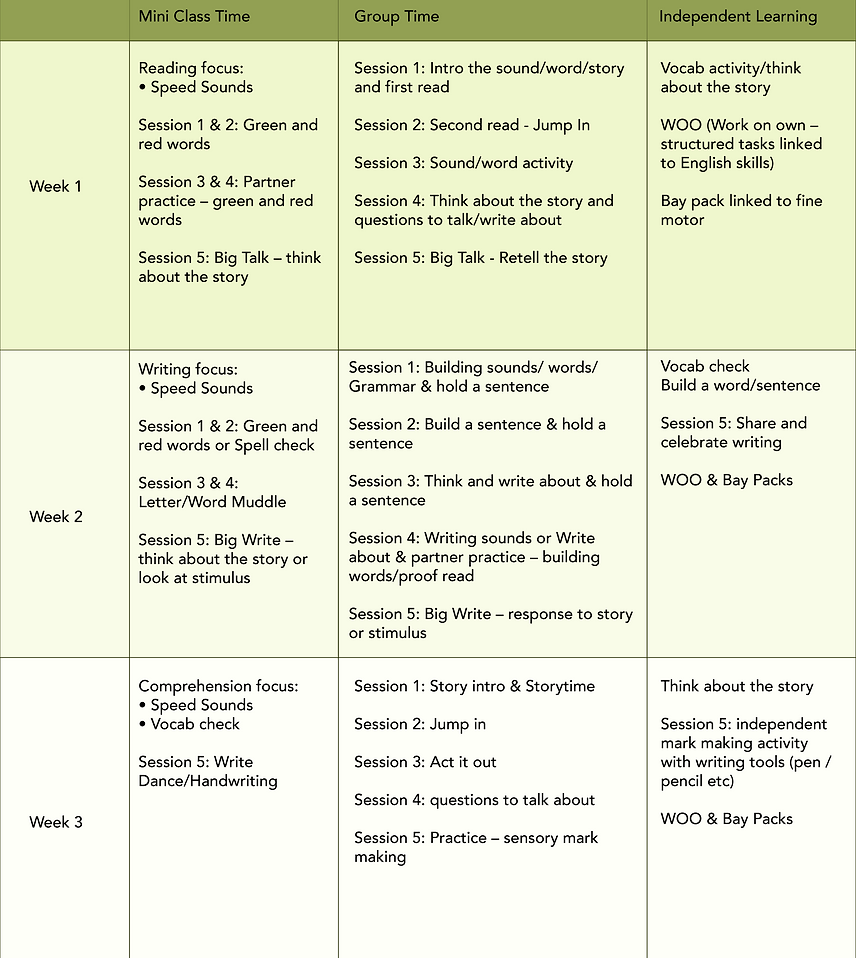
In addition to the English lesson, all children have a 20 minute ‘Share a Story’ session once a day. This could involve a story time with an adult reading to the whole class/small groups, small group and pair reading activities, one-to-one reading with an adult, or independent reading. This reading time can take many forms and we aim for the children to experience a variety of different types of reading and texts including electronic and interactive reading materials and stories.
Each class also has a library session once a week to provide an opportunity for children to choose a book to read at home, as well as build computing skills in using the self-checkout scanning system. Adult will select an appropriate book match to the child phonics level (RWI scheme), or for children who are not yet reading, a suitable picture book to share at home. Books will be changed once a week and for families who would like more books these can be provided.
Staff should read with children 1:1 at least once a week and write a comment in the reading record, as well as initially the comment. Reading Records are match to each child’s reading level and have helpful prompts for the skills focus, example comments and activities ideas to support learning. Appropriate Blank Level and Narrative Approach questions are on the back page of the Reading Record to help discuss the story with the child.
English Curriculum Impact:
In order to match work to pupils' ability, diagnostic andformative focussed assessment opportunities will be plannedfor by individual teachers through the use of:
-
The Engagement Profile
-
The Foundation Stage profile for children in Reception
-
Key performance indicators (KPI)
-
Individual Targets for English Schemes of Work and short term planning
-
RWI assessments
Progress is recorded against the group/individual objectives set by the adults working with the children and these should inform and allow teachers to adapt short term planning.
Progress is annotated with dates on the GEP and highlighted on the electronic assessment tool. New targets are then set. Informal evaluations are also made on short term planning.
Assessments using the Read Write Inc scheme are completed as a baseline where needed and at the end of every term. For those children whose progress is a concern, interim assessment may be completed to ensure interventions in place are having impact.
Reading at home
Books for shared reading should be sent home weekly and changed on a regular basis.
Once children begin the RWI scheme, one book will be closely matched to the phonics level they are working at and the step in the RWI scheme they are working on (Appendix 1).
A reading record is provided with information linked to the objectives the children is working on to support both reading at home and in school.
Children have access to the ‘Busy Things’ and ‘Oxford Owls’ website at home.
We are proactive in supporting parents and host sessions to support parents with reading at home and phonics.


Maths
At Maple Ridge we teach Maths in a way which excites and engages children in the national curriculum, this allows them to apply their skills in a practical and ‘real world’ way and make links between numeracy and their learning in other areas such as topic. We prioritise the skills which will enable children to be as independent as possible and develop life skills, such as time, money and basic calculations.
To do this we use concrete and visual resources, embedding and mastering the important skills needed to make the next steps in their learning. Teachers and adults use Group Education Plans (GEPs) to set clear next step targets which we share with the children and home each half term. These targets also help us to ensure all children’s learning is individualised for their needs.


PSHE
PSD (personal social development) and PSHE (Personal, social and health education)
To support our PSD/ PSHE curriculum we aim to promote the spiritual, moral, social and cultural (SMSC) development supporting positive behaviour, personal development and good mental wellbeing in our pupils, we have introduced the characters Kimmy Kind, Herman Helpful and Sammy Safe to support our school rules of Be Kind, Be Helpful and Be Safe.


We have incorporated the PSHE association and SEND planning doc key themes to enable breadth and depth of subject based PSD/PSHE. These include; Self-Awareness, Self-care, Support & Safety, Managing Feelings Changing & Growing, Healthy Lifestyles and the The World I Live in. We tech circle time and turtle time weekly.
We use aspects from the PATHS framework for children to explore feelings and self-regulation skills when they are ready. They meet Twiggle, the turtle puppet, and learn how to ‘do turtle’.
Activities are tailored to meet the needs of the children and may include a free flow selection of activities linked to focused areas of learning. At Maple Ridge we place a high importance on the teaching of personal and social education. We aim to allow, support and teach children to communicate how they and others show feelings, communicate about their own and others’ behaviour and its consequences, and begin to understand that some behaviour is unacceptable.
They start to work as part of a group or class and understand and follow the rules. They try to adjust their behaviour to different situations, and begin to accept changes in routine. We aim to develop children’s skills in emotional literacy, behavioural self-control and problem solving in order to promote social and emotional competence.
